Automated Lead Nurturing: The 28-Touch Rule for Converting B2B Leads
We have been lied to. The gurus told us that if we built a "funnel," the sales would come. They told us that if we sent three emails, the lead would buy.
The data says otherwise. In 2026, the average B2B conversion requires 28 digital touches before a prospect even considers pulling out their credit card.
If you are manually trying to "nurture" leads, you will fail. You cannot physically follow up 28 times with 1,000 leads. It is a mathematical impossibility.
This is why Automated Lead Nurturing is the only viable strategy. You need an automated ecosystem—a "Digital Spiderweb"—that surrounds your prospect with value from every angle, without you lifting a finger.
Understanding the 28-Touch Rule
The 28-Touch Rule is a foundational principle in B2B marketing that states prospects require an average of 28 meaningful interactions with your brand before they're ready to make a purchase decision. This isn't a magic number pulled from thin air—it's backed by extensive research in multi-channel marketing dynamics.
What Is a "Touch"?
A touch is any meaningful interaction between your prospect and your brand. This includes: - Email opens and clicks - LinkedIn post views and engagements - Website visits - Social media interactions - Ad impressions - Direct messages - Video watches - Webinar attendance - Content downloads
Industry Variations
The 28-touch baseline varies by industry based on deal complexity and sales cycles: - Enterprise SaaS ($50k+ contracts): 35-45 touches required - B2B Consulting ($5k-$25k): 25-32 touches - SaaS Products ($100-$1000/month): 15-20 touches - Coaching/Done-For-You Services: 20-28 touches
For detailed B2B benchmarks and industry-specific data, industry research firms track these metrics extensively. The key insight? Multi-channel matters. A single email channel is insufficient. You must create a multi-touch, multi-channel strategy that meets prospects where they are, when they're ready to engage.
The "Omni-Channel" Ecosystem
The 28-Touch Rule isn't about spamming them with 28 emails. That's harassment. It's about showing up where they live: * Touch 1-3: They see your content on LinkedIn (Automated posting). * Touch 4: They comment, and your ManyChat bot sends them a free resource (Instant Value). * Touch 5-10: They are entered into a newsletter sequence (Email Nurture). * Touch 11-20: They are retargeted by your ads on Instagram (Paid Social). * Touch 21-28: They receive a personalized video via Bland AI or HeyGen (Hyper-Personalization).
By the time they book a call, they feel like they know you. You haven't "sold" them anything. You have simply existed in their world for 30 days straight.
The Architecture of Ubiquity: Building Your Implementation
To execute this, you need more than just a CRM. You need an interconnected stack built on proven automation principles. Inside the Builders Lab Pro, we build this exact architecture: 1. The Content Engine: Using AI to generate daily LinkedIn/Twitter posts. 2. The Capture Layer: Turning engagement into email subscribers instantly. 3. The Nurture Loop: A perpetual email/ad sequence that never lets a lead go cold.

Implementation: 4-Step Setup Process
Setting up a 28-touch automation machine requires strategic planning. Here's the proven framework:
Step 1: Map Your Customer Journey Identify every touchpoint a prospect experiences from awareness to decision. Document where they first discover you (organic search, LinkedIn, referrals) and create a visual map of their journey. Define what "ready to buy" looks like in your specific market.
Step 2: Build Your Content Library Create 3-4 months of valuable content across formats: - Blog articles (long-form, SEO-optimized) - LinkedIn carousel posts and short-form content - Email sequences (educational, case studies, testimonials) - Video content for ads and personalization - Lead magnet resources (checklists, guides, templates)
Step 3: Configure Your Email Sequences Using an email automation platform, build layered sequences: - Welcome sequence (days 1-3) - Educational nurture (days 4-14) - Social proof sequence (days 15-21) - Urgency/offer sequence (days 22-28)
Step 4: Execute Multi-Channel Touches Implement simultaneous channels so touches compound: - Email: 5-8 emails across the 28-day cycle - Social Ads: LinkedIn and Facebook retargeting (daily) - Organic Social: 3-4 weekly LinkedIn posts - Direct Outreach: Personalized LinkedIn DMs (5-7 total) - Video: 2-3 personalized videos at decision points
Why "Low Volume, High Touch" Wins
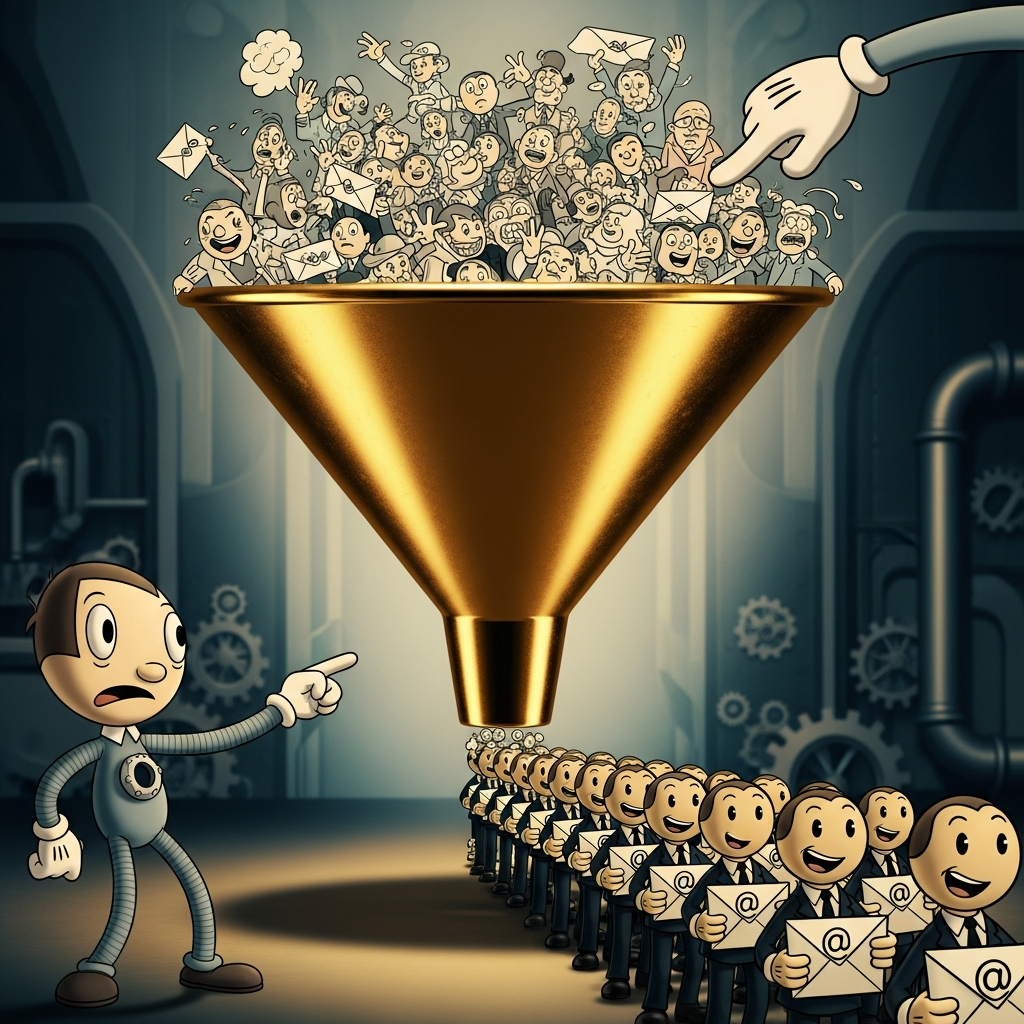
The old way was "High Volume, Low Touch." Blast 10,000 people with a generic message and hope 1 buys. The new way is "Low Volume, High Touch." Target 1,000 perfect prospects and hit them 28 times with hyper-relevant value.
The result? You stop burning leads. You stop being ignored. You start being seen as an Industry Authority.
Measuring Success: Metrics That Matter
You can't improve what you don't measure. Here are the 5 KPIs that matter most for 28-touch nurturing campaigns:
1. Engagement Rate
- Baseline: 2-5% (average across all touches)
- Target: 8-12% (exceptional)
- What to track: Email open rates, link clicks, video watch time, social engagement
- Why it matters: Engagement indicates your content resonates before they ever speak to sales
2. Conversion Rate (Qualified Lead)
- Baseline: 2-4% (contacts → qualified leads)
- Target: 6-10%
- What to track: Form submissions, demo requests, consultation bookings
- Why it matters: This is where the 28-touch strategy proves its ROI—nurturing drives qualified opportunities
3. Sales Cycle Compression
- Baseline: 60-90 days (from first touch to closed deal)
- Target: 30-45 days
- What to track: Days from first automation touch to demo, demo to proposal, proposal to close
- Why it matters: Well-executed nurturing dramatically reduces decision time
4. Cost Per Lead (CPL)
- Baseline: $15-$40 (depends on your market)
- Target: $10-$25 (better targeting + automation efficiency)
- What to track: Total campaign spend ÷ qualified leads generated
- Why it matters: Efficiency matters; automated systems should lower your cost per acquisition
5. Return on Investment (ROI)
- Baseline: 2:1 to 4:1 (for mature campaigns)
- Target: 5:1 to 8:1
- Calculation: (Total revenue from campaign - Total cost) ÷ Total cost × 100
- Why it matters: Ultimately, your campaigns need to generate revenue, not just engagement
Pro Tip: Track these metrics at each "gate" (Day 7, 14, 21, 28) to identify where prospects drop off and optimize your sequences accordingly. For deeper insights on lead nurturing best practices, refer to industry research and case studies.
Conclusion: Build the Web
You can't outwork the math. If it takes 28 touches to close a deal, and you only have time for 3, you are leaving 90% of your revenue on the table.
Build the web. Automate the touches. Let the system do the heavy lifting.
Frequently Asked Questions (FAQ)
What counts as a "touch" in marketing?
A touch is any meaningful interaction a prospect has with your brand. This includes reading an email, seeing a LinkedIn post, watching a video ad, receiving a DM, or visiting your website.
Is 28 touches really necessary?
For high-ticket B2B sales ($2k+), yes. Trust takes time to build. For low-ticket items ($50), the number is lower (usually 5-7 touches).
How do I automate touches without being annoying?
Diversify your channels. Don't send 28 emails. Send 5 emails, show 10 ads, post 10 times on social, and send 3 DMs. This feels like "market presence" rather than "inbox spam."
Is 28 touches the magic number for ALL industries?
No. The 28-touch benchmark is most effective for enterprise and mid-market B2B. Your specific magic number depends on: - Buying complexity: More stakeholders = more touches needed - Price point: Higher ticket = higher touch count (35-45 for $100k+ deals) - Industry maturity: Saturated industries need more differentiation (more touches) - Sales cycle: Complex deals with longer evaluation periods need sustained touchpoints
Run A/B tests to find your sweet spot. Some industries convert at 15 touches; others need 40. Data beats theory.
How do I avoid touch fatigue and spam complaints?
Touch fatigue occurs when prospects feel bombarded. Avoid it with these tactics: - Channel diversity: Spread touches across email (30%), ads (40%), organic social (20%), direct outreach (10%) - Content quality: Every touch must provide value; never waste their attention - Preference center: Let prospects choose touch frequency and content types - Frequency caps: Email no more than 2-3x/week; ad frequency cap at 3-5 impressions/day - Segmentation: Don't send the same sequence to everyone—customize by persona, industry, company size - Engagement gating: If someone doesn't engage with Touch 1-5, reassess whether they're a good fit
Monitor unsubscribe rates and spam complaints. If either exceeds 0.5%, audit your messaging and reduce touch frequency.
What's the ROI timeline for implementing this strategy?
Short-term (Month 1-2): Focus on setup and audience qualification. Expect 0% ROI; this is investment phase. Medium-term (Month 3-4): Early leads entering your pipeline. 1:1 ROI as first sales close. Long-term (Month 5-6+): System compounds. Expect 3:1 to 5:1 ROI as you refine based on data.
Key factors affecting timeline: - Sales cycle length (longer cycle = longer timeline to ROI) - Audience size (smaller, targeted list converts faster than large, cold list) - Product/service price (higher ticket = more time to prove ROI) - Implementation quality (well-built sequences show ROI faster)
Most businesses see positive ROI by month 3-4 if properly executed. If you're not seeing improvement by month 4, audit your audience quality and message-market fit.
READY TO BUILD YOUR WEB?
Stop chasing leads and start surrounding them.
Join the Builders Lab for just $49.99/month.
The Fast-Action Bonus: The first 10 people to join will get a 1-1, 45-minute Strategic Planning or Debug Session with me. I will personally map out your 28-Touch Ecosystem.
Metadata for SEO agent: